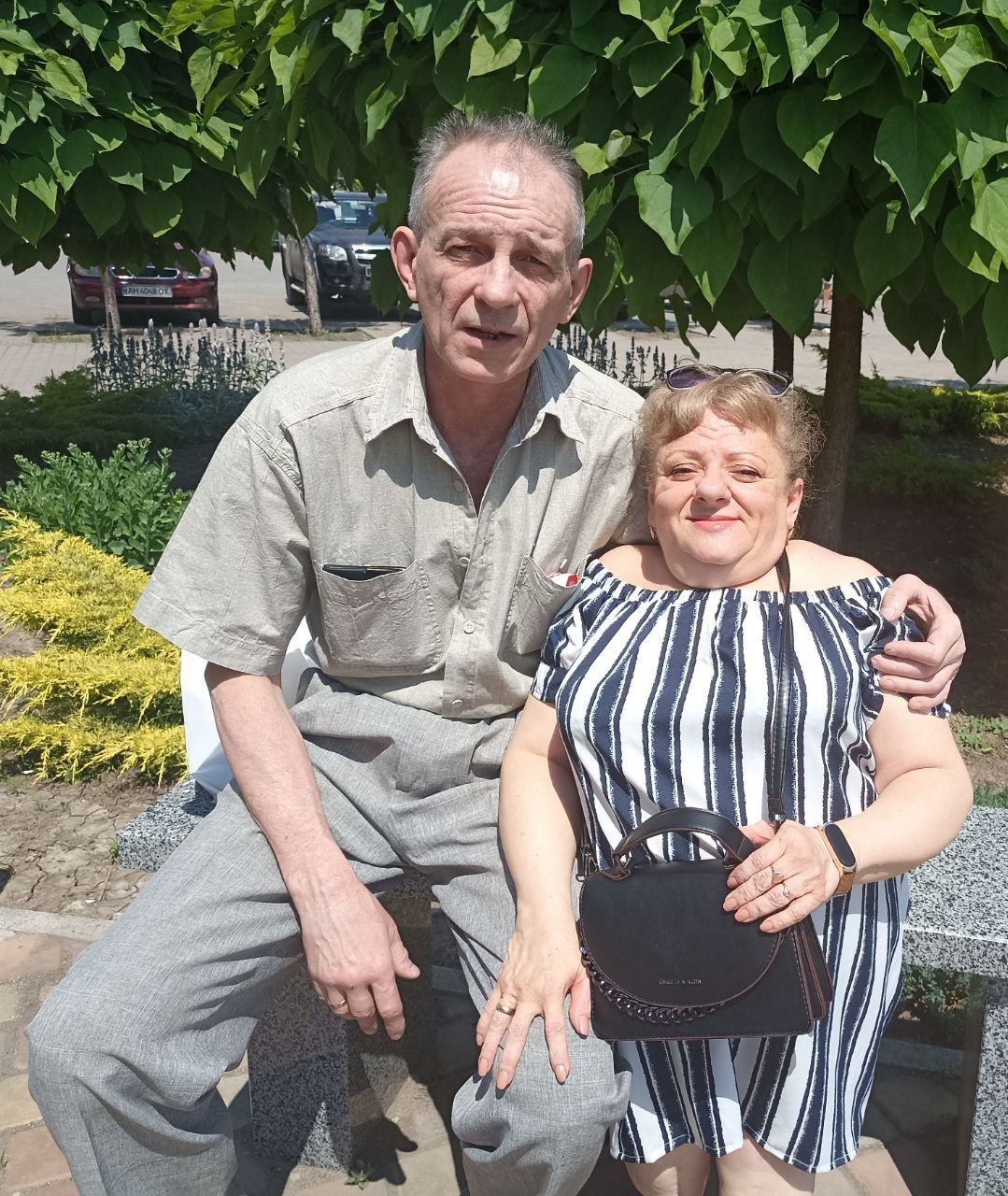
From survival to medical treatment: how evacuation and access to healthcare changed the lives a couple from a frontline town
The story of Olena and Oleksandr from Donetsk Oblast
Olena and Oleksandr are one of those families who found themselves in a particularly vulnerable situation due to the war. Living in Kostyantynivka, Donetsk region, they not only endured constant shelling and threats to their lives, but due to Olena's health condition, evacuation required special efforts, and access to medical care, which was already insufficient in peacetime, became significantly more difficult in the conditions of hostilities.
The full-scale invasion found Olena and Oleksandr in Donbas, in Kostyantynivka. Even then, their circumstances were particularly vulnerable. Due to the woman's congenital bone fragility, any travel posed a serious risk, whereas with the onset of intense shelling, evacuation became a matter of survival.
Before they left, the family was living amid constant bombardments. Oleksandr was working as a physician and stayed in the city until the very end — there were still people there who needed help.
The final push for the evacuation came with intensified shelling. Shells and missiles would whiz right over their heads, blasting out the windows in their home. After the couple had left, the strikes would hit one part of the building and then another. The family's apartment has now been completely burned out. It later came to light that at half past four in the morning there had been a direct hit — if they had stayed, they would have had almost no chance of survival.
The evacuation route was complicated and lengthy. Due to Olena's health condition, they were transported by ambulance. Even en route, they remained in danger: a russian army drone was chasing after the vehicle. First, the family was taken by car and an armored vehicle through Pavlohrad to Dnipro. There they spent two weeks in a hospital while Oleksandr's [foreign] passport was being urgently issued — without it, leaving the country was impossible. Then they traveled to Warsaw, where they waited for a plane for two weeks while once again staying in a hospital.
Olena found out about Helping to Leave by accident. She rang her friend in Kharkiv, who then gave her the number for the Red Cross. They informed her that they did not handle evacuations themselves but referred her to Helping to Leave. Olena managed to get in touch with the project and got help in arranging their departure. In Dnipro, the family was assisted with their documents — they needed only pay for the expedited issue of their passports.
From Warsaw, the couple flew to Copenhagen. It was Olena's first-ever flight.
“At first, I just held on to my husband, and then I saw that we were flying above the clouds, as if above the sea between the mountains. It was incredibly beautiful,” she recalls.
In Denmark, the family was placed in the Sandholm refugee center. The conditions were modest but sufficient: a separate room with beds and furniture, a shared kitchen, shower, and toilet. Volunteers provided them with clothing and cooking utensils, and they had access to a free thrift store. It was there that the couple first felt safe and cared for: in Warsaw and Denmark they were fed, provided with medication, and accompanied on the road and during layovers.
Now Olena and Oleksandr live in the city of Hamm. Supermarkets and other stores are nearby, and there is a Ukrainian community, although people from various countries live in the area. The locals always say hello and smile, while cashiers offer discounts, and people recognize them in stores.
“It's so clean here: no cigarette butts, no litter. We even carry a jar for our cigarette butts around with us,” says Olena. According to her, after everything they've been through, Denmark seems like paradise, considering that they had almost lost hope of surviving back in Ukraine.
Access to medical care was a separate and decisive factor in their adaptation. The family received comprehensive and high-quality medical care immediately after their arrival. Olena has had a complex diagnosis since childhood and has undergone several difficult operations in her lifetime. Treatment in Ukraine had been extremely expensive: part of the procedures and medications had to be paid for out of pocket, and the funds for the operations often had to be raised by volunteers.
In Denmark, medical care was not only accessible but also systematic. Here, she underwent procedures that would have cost tens of thousands of hryvnias in Ukraine free of charge, with the state fully or partially covering the cost of necessary medications. The woman was supplied with an adjustable electric wheelchair, an orthopedic bed, a rollator walker, and an individual rehabilitation plan with regular physiotherapy sessions.
They've gradually settled into their new life. At first, the new home seemed unfamiliar and uncomfortable, but over time, the couple managed to make it cozy all by themselves. They bought some things at second-hand and consignment stores, and others they got for free. They have enough money: pensions and local benefits cover all their basic needs.
Looking back, Olena says she is still amazed at how her life has changed.
“In Warsaw, we were happy to see the planes — simply for the fact that they were up in the air. At home, planes only meant danger,” she says.
Despite their hardships, the family is grateful to the volunteers and everyone who helped them flee to safety.
Currently, due to limited resources and cuts in support programs abroad, it is becoming increasingly difficult to evacuate people with serious illnesses.
We have clear criteria for assistance, approach each application individually, and try to find options for accommodation and medical care in Ukraine as well.
Interview and story by Yuliia Kalaban